Why the Best Travelers Are Drawing Their Own Maps (And Keeping Them Secret)
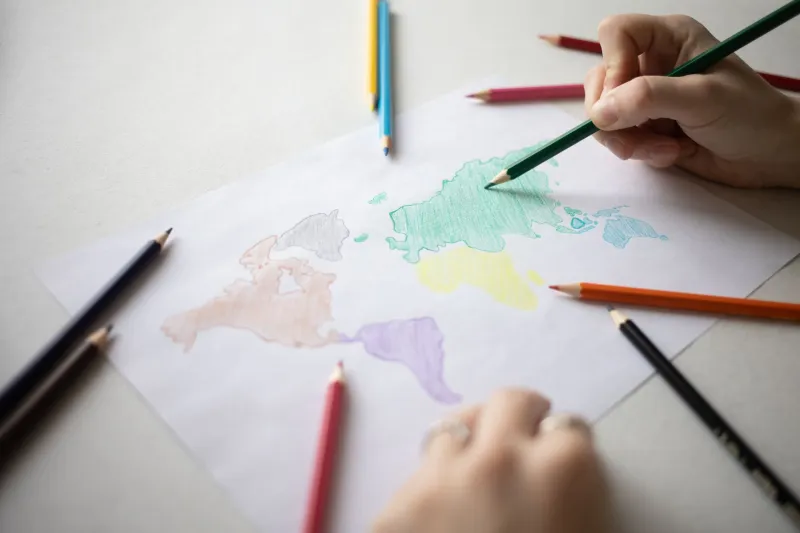
Somewhere in a Brooklyn apartment, a woman named Dara keeps a rolled-up piece of kraft paper tucked behind her bookshelf. On it, in colored pencil and ballpoint ink, is a map of her three favorite neighborhoods in Oaxaca, Mexico — marked not with streets or landmarks, but with feelings. This corner smells like copal smoke in the morning. Best light hits here around 4pm. Ask for the mezcal they don't put on the menu.
She's never posted it online. She's shown it to maybe four people.
"The second I share it on Instagram," she says, "it stops being mine."
Dara isn't alone. Quietly, a growing number of American travelers are pulling back from the infinite scroll of location tags, algorithmic recommendations, and influencer itineraries — and building something more intimate in their place: handmade, annotated, fiercely personal maps that live in physical space and travel only through trusted hands.
It's part cartography, part rebellion, and entirely fascinating.
The Algorithm Gave Us Everything Except Surprise
Let's be honest about what digital travel discovery has done for us. It's made planning easier, reduced the anxiety of showing up somewhere totally clueless, and surfaced genuinely great spots that might have otherwise stayed invisible. No argument there.
But somewhere along the way, the tools we use to find places started shaping which places were worth finding. The same taco stand appears in 47 different travel reels. The same mural in Nashville gets photographed by thousands of strangers who all found it through the same hashtag. The same "hidden" waterfall in Oregon now has a parking lot and a two-hour wait on weekends.
The algorithm, it turns out, is extremely good at collapsing surprise. And surprise — genuine, unscripted, nobody-else-is-here surprise — is increasingly the thing travelers are actually chasing.
Personal maps are one answer to that problem.
What a Personal Travel Map Actually Looks Like
Forget the polished aesthetic of a Moleskine journal or a Pinterest-perfect flat lay. The maps serious travelers are making tend to be messy, idiosyncratic, and completely illegible to anyone who wasn't there.
They might include:
- Annotated neighborhood sketches with notes about time of day, light quality, or seasonal changes
- Crossed-out spots that used to be good but got discovered — a living record of a place's evolution
- Coded references only recognizable to the person who made them or the friends they've shared them with
- Emotional waypoints that don't correspond to any physical address: the block where the city started to feel familiar, the bench where a conversation changed something
- Blank zones — deliberately left empty, representing places the mapmaker isn't ready to share yet
This last detail is worth pausing on. The act of choosing what to leave off a map is itself a kind of ownership. It mirrors something cartographers have done for centuries — the deliberate omission as a statement of power, privacy, or protection.
The Psychology of Keeping a Discovery Close
There's real cognitive science behind why sharing a beloved place can feel like losing it. Psychologists who study ownership and identity talk about the "endowment effect" — our tendency to value things more once we feel they belong to us. A restaurant you stumbled onto alone feels different from one that showed up in your algorithmic feed. You found it. It's yours in a way that a recommendation never quite is.
When that place gets shared widely, something shifts. The experience becomes communal, and in becoming communal, it loses the texture of personal discovery. The crowd doesn't just change the physical space — it changes your memory of it.
Personal maps are a way of preserving that original feeling. They let you hold a place in amber, exactly as you experienced it, without subjecting it to the flattening effect of mass attention.
There's also something worth naming about trust. Sharing a hand-drawn map with a close friend is a fundamentally different act than posting a location tag. One is a gift; the other is a broadcast. The intimacy of the exchange changes what the information means.
The Social Dynamic: Maps as Currency Among Travelers
In certain corners of the American travel community — particularly among long-term road-trippers, outdoor enthusiasts, and people who take multiple international trips a year — personal maps have become a kind of social currency.
You don't just hand your map to anyone. You share pieces of it with people who've earned the exchange — friends who've brought you somewhere equally good, who understand the unspoken rule that the information stops with them.
This informal economy of place knowledge has always existed. What's new is the conscious, almost ritualistic way some travelers are formalizing it in response to the oversharing culture of social media. Making a physical map is a deliberate act. It says: this is worth protecting.
Some travelers are even holding what you might call "map swaps" — small gatherings where a handful of trusted friends trade annotated city sketches, each person bringing one place they've kept off the internet. The maps circulate. The places stay quiet.
So Should You Make One?
Here's the thing: you don't need to be a skilled illustrator, a seasoned world traveler, or someone with particularly strong opinions about cartography. The value of a personal map has almost nothing to do with its visual quality and everything to do with the act of making it.
Start small. After your next trip — even a weekend drive somewhere new — sit down with a blank piece of paper and try to reconstruct the place from memory. Not from your photos, not from Google Maps. From what you actually remember.
What you choose to draw, and what you leave out, will tell you something about what you actually paid attention to. That gap between the official map and your map? That's where your experience actually lived.
Annotate it. Mark the things that mattered. Cross out anything that disappointed you. Leave blank space for the things you're not ready to share — or that you want to go back and discover more fully before you do.
Then put it somewhere physical. A drawer, a folder, a rolled-up tube behind the bookshelf. Let it exist in the world without being indexed, tagged, or optimized.
The Bigger Idea Behind the Trend
At WonderMap, we spend a lot of time thinking about what it means to truly discover a place — not just visit it, but understand it in a way that feels earned. The rise of personal, secret maps is really just an extension of that instinct.
It's travelers reclaiming the act of discovery from systems that were never designed to protect the thing that makes discovery meaningful in the first place.
The best places in the world aren't the ones with the most check-ins. They're the ones that still have the capacity to surprise you — and the ones that stay surprising longest are usually the ones somebody, somewhere, decided not to post about.
Maybe that somebody should be you.