Wrong Turn, Right Place: The Glorious Failures of GPS That Became Someone's Best Trip Ever

Somewhere between "recalculating" and a dead cell signal, something interesting happens. The blue dot freezes. The confident robotic voice goes quiet. And you're left squinting at a road that definitely isn't on any map — at least not any digital one.
For most of us, that's a minor panic. But for a quietly growing number of travelers, it's become the opening scene of their favorite trip story.
When the Algorithm Blinks
GPS technology is genuinely remarkable. It can route you around a traffic jam in real time, warn you about a speed trap three miles ahead, and estimate your arrival down to the minute. But it also has blind spots — literal ones. Dead zones in rural Montana. Outdated road data in small Appalachian towns. Signal gaps in canyon country that send your routing into a quiet tailspin.
And in those gaps? Sometimes magic.
Travelers heading through the Texas Hill Country, for instance, have long complained — and then quietly bragged — about the stretch of US-290 where certain mapping apps inexplicably route drivers through Luckenbach, Texas rather than around it. Population: 3. Vibe: completely irreplaceable. More than a few people have stumbled into that dusty dance hall mid-afternoon on a Tuesday and decided they weren't leaving until sundown.
"I was supposed to be in Austin by noon," one traveler wrote in a Reddit thread that's been bookmarked hundreds of times. "I didn't make it until the next morning. Zero regrets."
The Towns That GPS Built (By Accident)
Ask the residents of Marfa, Texas — or Eureka Springs, Arkansas, or Taos, New Mexico — how their town got on the map, and you'll hear a complicated story involving artists, word of mouth, and a slow cultural drift. But increasingly, small towns across the country are getting a different kind of origin story: the accidental detour.
In Galena, Illinois, a well-preserved 19th-century river town tucked into the bluffs near the Wisconsin border, locals have noticed a pattern. Visitors often arrive looking slightly confused, phones held up like divining rods.
"They'll come into the shop and say they were trying to get to Dubuque and ended up here instead," says a shopkeeper who's run a vintage map store on Main Street for over a decade. "Half of them are annoyed for about five minutes. Then they walk around the block and they're completely converted."
Galena's Main Street — all Federal-style architecture and independent boutiques — tends to do that to people. It doesn't hurt that Ulysses S. Grant's home is there, preserved and open to visitors, waiting patiently for whoever the algorithm decides to send its way.
The Serendipity Gap
There's a term that travel researchers and urban planners sometimes use: induced demand. Build a road, and traffic fills it. But there's a lesser-discussed inverse: remove the certainty, and discovery rushes in.
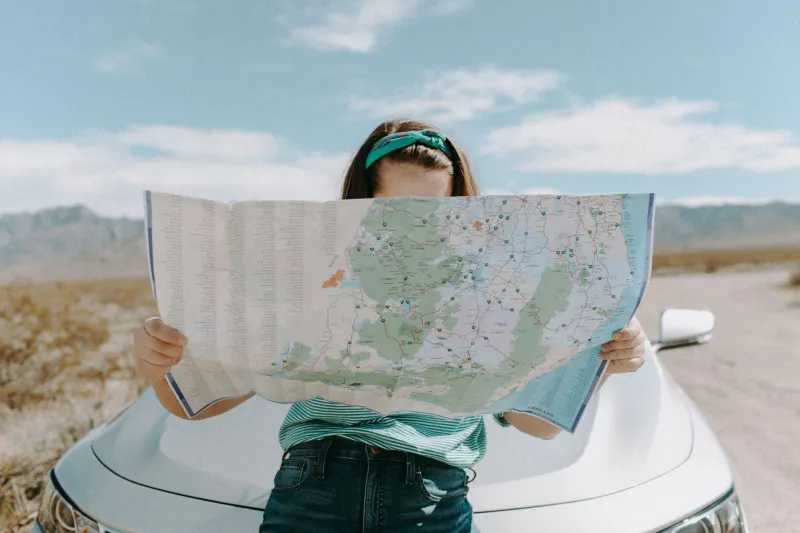
Before smartphones, getting lost was a full-contact sport. You pulled over. You unfolded a paper map — badly, always badly — and tried to figure out where the crease intersected with your current location. You asked someone at a gas station. That someone told you about the diner two exits back. You went to the diner. The diner changed your life.
The smartphone era compressed that whole process into a rerouting notification. Efficient, yes. But something got lost in the optimization.
"There's a reason people talk about their pre-GPS road trips the way they do," says a travel writer who's been covering American road culture for nearly twenty years. "The friction wasn't just inconvenience. The friction was the experience."
GPS failures — maddening as they are in the moment — occasionally recreate that friction. They force a pause. They create a gap in the itinerary that something real can fill.
How to Let the Wrong Turn Work For You
Here's the thing: you don't have to wait for your navigation app to malfunction. You can engineer the conditions for a productive wrong turn. Some ideas that actual travelers swear by:
Turn off the ETA. Seriously. When you're not watching a countdown clock, you stop treating detours like losses. A side road becomes a possibility instead of a penalty.
Download the map, then ignore it. Having offline maps means you're not stranded if you wander. But consciously choosing not to follow the fastest route? That's where the good stuff lives.
Ask about the back way. At any gas station, diner, or hardware store in rural America, mention that you're not in a hurry and ask if there's a prettier route. You will not be disappointed. Americans who live somewhere beautiful and undervisited are often desperate to share it with someone who has time to appreciate it.
Follow the sign you weren't expecting. Brown highway signs — the ones indicating historic sites, scenic overlooks, and state parks — are the original algorithm. They were placed by people who wanted you to stop. Stop.
The Hidden Gem Problem
There's a tension worth naming here. The same serendipity that makes an accidental detour magical is exactly what a place loses once it becomes famous for being accidentally discoverable. Marfa was a secret until it wasn't. The same fate has found dozens of small towns that got too much love too fast.
But GPS dead zones, outdated maps, and gravel roads that don't quite connect the way the app thinks they do — those create a kind of natural filter. The traveler who ends up in a small Missouri river town because their phone lost signal on the highway is, almost by definition, someone who's flexible, curious, and not in a hurry. That's exactly the kind of visitor a small town can absorb without being overwhelmed by.
The algorithm's failures, in other words, might be doing some of the best curation work in travel.
A Different Kind of Wonder
At WonderMap, we spend a lot of time thinking about how people find the places that matter most to them — and how those places stay worth finding. The answer almost never involves a sponsored post or a trending hashtag. More often, it involves a moment of uncertainty. A road that looked wrong on the screen. A town that wasn't in the plan.
The next time your GPS hesitates, consider not immediately reaching for a workaround. Give the pause a minute. Look around. Ask someone.
The best places on the map are often the ones the map didn't mean to show you.