Why the Places You Loved Most Are the Hardest to Find Again
There's a particular kind of heartbreak that travelers rarely talk about out loud. It's not losing your passport or missing a flight. It's returning to a place you genuinely loved — a narrow street in New Orleans, a lake town in Vermont, a taco stand in San Diego you'd sworn you'd never forget — and finding that it just doesn't feel the same. The place is still there. You're still there. And yet something is gone.
Call it the cartography of regret. The map exists, the coordinates are correct, but the destination you're looking for has quietly moved somewhere no GPS can reach.
Memory Is a Terrible Mapmaker
Here's the uncomfortable truth: your brain is not a reliable archivist. Every time you recall a memory, you're not playing back a recording — you're reconstructing it, and each reconstruction is slightly different from the last. By the time you've told the story of that perfect evening in Savannah a dozen times at dinner parties, the memory has been edited, romanticized, and smoothed out until it's something closer to mythology than fact.
So when you go back, you're not comparing a real place to a real memory. You're comparing a real place to a story you've been telling yourself for years. The real place is going to lose that contest almost every time.
Psychologists call this "rosy retrospection" — the tendency to remember past experiences more positively than we actually felt them in the moment. That weekend in Asheville where it rained on Saturday and you argued about where to eat dinner? In memory, the rain becomes atmospheric and the argument becomes a funny story. The place gets credit for all of it.
The Town Changed. So Did You.
Even setting memory aside, places genuinely do change — and often faster than we expect. Gentrification reshapes neighborhoods in ways that are hard to predict and harder to reverse. The dive bar that felt like a secret becomes a cocktail lounge with a waiting list. The fishing village that nobody talked about gets written up in a major travel magazine, and within two seasons, there are vacation rentals on every block.
This is especially true of smaller American towns that hit a cultural moment. Think of how many "hidden gems" have followed the exact same arc over the past decade: a few travel writers discover them, Instagram amplifies the signal, a wave of visitors arrives, and the local economy reshapes itself around tourism. The charm that drew people in the first place often gets commodified in the process — turned into a product sold back to the visitors who came looking for authenticity.
But here's the part that's easier to miss: you changed too. The person who fell in love with that mountain town in Colorado was at a specific point in their life — maybe between jobs, maybe newly single, maybe just old enough to start paying attention to the world. You can go back to the town, but you can't go back to that version of yourself. And often, that version of yourself is what you're really trying to find.
What You Can Actually Preserve
If memory distorts and places shift, is there anything worth trying to hold onto? Probably — but the method matters.
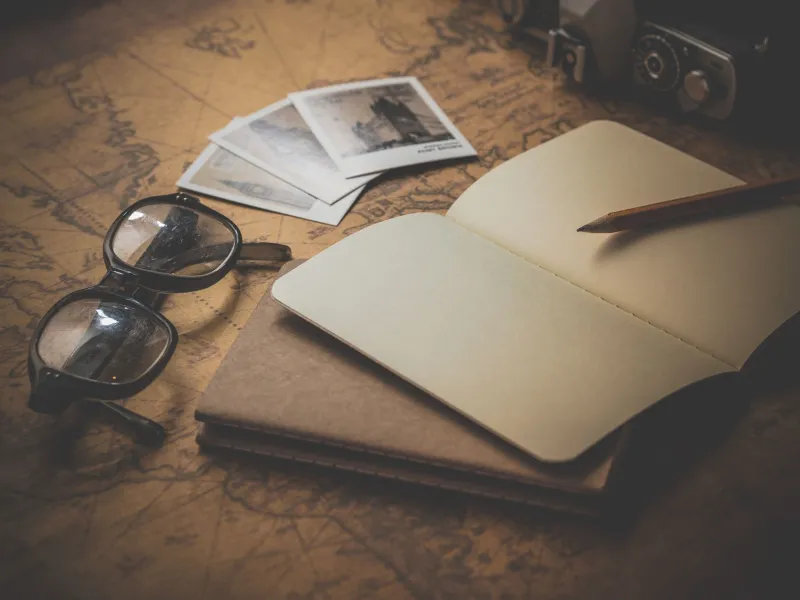
Travel journals are underrated precisely because they capture the unedited version: the blisters, the mediocre meals, the moments of boredom between the highlights. Reading back through a detailed journal from a trip is almost always more surprising than you'd expect, because it includes things your memory quietly deleted. That's the point. The written record doesn't romanticize.
Photography helps too, but selectively. The most useful travel photos aren't the iconic shots — those are already everywhere online. The useful ones are the mundane details: the menu board, the name of the street, the view from your specific window. These are the things that actually jog real memory rather than performed memory.
Some travelers have started keeping what they call "place files" — simple notes that go beyond what happened and try to capture what something felt like. The quality of the afternoon light. The particular sound the city made at 6 a.m. The way the air smelled after rain. These sensory anchors are harder to preserve but closer to what we're actually trying to hold onto.
The Case for Not Going Back
There's a school of thought — and it's worth taking seriously — that revisiting beloved places is almost always a mistake. Not because the places are worse, but because the first visit was complete in itself. It had a beginning, a middle, and an end. Going back is essentially asking a finished story to have a different ending.
Some of the most experienced travelers will tell you privately that they have a quiet policy: certain places are visited once and left alone. Not because they didn't love them, but because they did. The memory stays intact. The place stays mythologized. Nobody gets disappointed.
This isn't avoidance — it's a kind of respect. For the place, and for the experience you had there.
Moving Forward as a Travel Philosophy
WonderMap exists on a pretty simple premise: the world is enormous, and most of it is still waiting to be found. There are places out there right now that will mean as much to you as any destination you've ever loved — maybe more. They're not on your radar yet. They might not even be on most people's radar.
The traveler who spends energy trying to recreate a past experience is, in a real sense, not fully available to new ones. There's a cost to looking backward too long.
None of this means you should never return anywhere. Some places reward repeat visits in ways that have nothing to do with recapturing the past — they're just genuinely good, year after year, in different ways depending on when you arrive and who you've become. The Grand Canyon doesn't care how many times you've seen it. Neither does New Orleans.
But when the goal is specifically to feel what you felt before? That's usually a trip that ends in disappointment, because what you felt before wasn't just about the place.
The Map You're Actually Reading
Maybe the most honest thing to say about the cartography of regret is this: the map you're trying to follow was never really a map of a place. It was a map of a moment — a specific intersection of location, timing, company, and personal circumstance that produced something rare.
You can't navigate back to a moment. But you can stay curious enough, and open enough, to stumble into new ones.
That's the whole point of exploration. Not to find your way back, but to keep finding your way forward — to places that haven't made it onto anyone's map yet, including yours.